Norrin AI Transparency Statement
Norrin uses AI in our own work, and you have a right to know when and how. This statement explains our approach to AI transparency: why we disclose our AI use, how we use AI tools, how we label AI-assisted and AI-generated content, and how we meet and go beyond our obligations under the EU AI Act.
This statement is reviewed at least once a year, when we make a significant change to our approach to AI transparency, and whenever a new factor, such as a regulatory change, affects its accuracy. This statement leans on Norrin’s internal AI Policy and AI transparency guidelines.
Why AI transparency matters
Transparency about AI use is both a legal obligation and a matter of trust. Clear disclosure protects the integrity of our work, reduces the risk of undisclosed errors, and lets you calibrate your own trust in what we deliver. We also believe it should be transparent when AI has been used in a substantial manner: whether that be summarizing human-written text, formatting a document to look better, or helping with meeting transcripts, it should be disclosed.
Transparently disclaiming AI use when necessary is a low-effort but high-impact way of making sure our information ecosystem stays trustworthy, and we can continue using AI tools to make our work more efficient.
While the EU Artificial Intelligence Act gives minimum requirements, at Norrin we go beyond those to ensure collaboration is built on trust and transparency.
We treat transparency as a quality and trustworthiness signal, not a warning label. We build AI transparency into how we work: disclosure is combined with human accountability, AI governance, and continuous refinement. For our clients and partners, our openness about AI is a statement of how we practice responsible AI.
Our obligations under the EU AI Act and the extra steps we take
Under the EU AI Act, Norrin acts as a deployer of AI systems: we use AI tools under our own authority in the course of professional work. As a deployer of only limited risk or minimal risk systems, we are required to disclose artificially generated image, audio and video content that constitutes a deep fake; and to support the AI literacy of our employees (Article 4). We meet these obligations and strive for continuous improvement of our AI compliance practices.
Beyond the legal baseline, we choose to go further:
-
Proactive responsibility. The AI Act requires providers to mark all synthetic audio, image, video or text content to be detectable as AI-generated or manipulated. We know not all providers offer this on the same level and have developed our own framework for employees to provide AI disclaimers ourselves when provider disclaimers don’t cut it.
-
Broader marking. The AI Act requires disclosure in specific cases; we mark AI-generated and substantially AI-assisted published content, internal and external.
-
Human verification of everything. No AI output reaches a client or the public without review by a qualified person who owns the result.
-
Governance and accountability. Our AI use is governed by our internal AI governance framework, which includes e.g. our internal AI Policy, an AI governance board, AI tool and skill management, and incident reporting practices with records kept to support audit and continuous improvement.
-
Standards. We are working towards the ISO/IEC 42001 AI management system standard and use ISO/IEC 42005 to guide AI system impact assessments. We are also soon to be ISO27001 certified.
How we use AI tools
Norrin uses AI tools to support everyday professional work, for example, brainstorming, drafting, summarization, translation, code assistance, data analysis, and research. AI supports Norrin’s employees; it does not replace human expertise. The following principles govern our AI use:
-
A human is always responsible. Every AI output is verified by a qualified person before it is used or published.
-
Approved tools only. We use only AI tools that are in accordance with Norrin’s security, privacy, and AI compliance requirements.
-
Data is protected. We follow strict data classification rules. Confidential and client data is only entered into AI tools with explicit consent, and secrets, credentials, and sensitive personal data are never entered into AI tools.
-
Client rules come first. In client work we obtain written permission before AI-assisted work begins, use client-approved tools and environments, and apply the client’s own AI and data requirements. Where a client’s rules are stricter than ours, theirs apply.
-
AI literacy matters. Norrin’s AI Literacy program supports all our employees in understanding AI compliance, responsible AI practices and our AI transparency measures.
-
Incidents are taken seriously. Norrin maintains a clear process for incident management regarding AI tools, and provides paths for reporting even small concerns, questions or comments regarding AI use – also anonymously. Employees know what to do if they encounter an issue with an AI tool, or want to raise a concern about AI use.
-
No prohibited or high-risk use. Norrin does not deploy or provide AI systems that fall under the EU AI Act’s prohibited practices or high-risk classification.
Labelling AI-generated and AI modified content at Norrin
We label all AI-generated and substantially AI modified content that we publish internally or externally. Standard minor editing such as spellchecking, grammar corrections, formatting, or meaning-preserving translation does not require a label, as per the EU’s guidance on transparency. We use our own AI transparency labels, applied through three markings or by text.
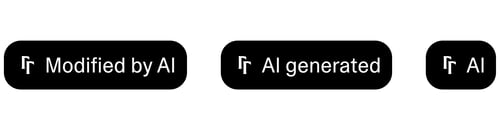
Generally, we label AI use with the wording “Norrin utilizes AI in its work.”. However, in occasions where we want to explicitly define where AI has been used, we label it using the icons below or define it through text.
-
Modified by AI is used for existing content that AI has changed in meaning or substance, such as meaning-changing rewrites or substantial image edits.
-
AI generated is used for content created by AI, such as AI-written text, summaries, transcripts, or generated visuals.
-
AI used is for any AI involvement, when content is both generated and modified, or when the distinction is unclear.
Working with you
We share this statement with clients when delivery work begins. If you have your own AI transparency and disclosure requirements, those take precedence and we apply them in our work for you. If you would like more detail on how we govern and disclose our AI use, or have any questions about this statement, please contact us.