When organizations grow, complexity does not only increase in structures or headcount. It increases in interpretation. The same situation can be understood in multiple ways, the same decision can feel fair or arbitrary depending on perspective, and the same behavior can signal trust or uncertainty, depending on the context.
This is why values matter. We approached defining our values as a process of making existing patterns visible across teams, histories, and ways of working.
Norrin was formed through the integration of different companies, each bringing their own implicit norms: how decisions are made, how responsibility is distributed, how near or far the leadership is perceived to be. These norms are rarely formalized, but they still shape our behavior and emotions.
The work with values started from what already existed
Rather than replacing the three existing sets of values with a new one, we started by examining them. What is already present? What is working? Where interpretations begin to diverge?
Initial value proposals, based on the existing values of the three companies, helped us start the conversation, but they also made something visible: language alone does not create shared understanding. To understand this better, we took the work into teams. Norrin’s Team Leads facilitated discussions in their teams where they discussed, iterated and gave feedback on the proposed values. The focus was on interpretation and how these ideas actually show up in daily work. The feedback was specific and grounded. Some suggested values were seen as too abstract, others as too performance-oriented.
What do growth, impact and care mean at Norrin?
Through this process, three values emerged that felt both accurate and useful:
-
Growth – we build expertise together
-
Impact – we create meaningful solutions
-
Care – we foster a safe and inclusive community
Growth refers to the development of shared capability. How knowledge moves, how expertise evolves together, and how people contribute to something larger than their individual role. Impact shifts attention from output to outcome, introducing a continuous question into everyday work: does what we are doing matter, and for whom? Care addresses the conditions under which all of this happens. Psychological safety, respect, and inclusion are what make sustained performance possible. Values related to achievement and impact co-exist with values related to care, belonging and security.
Why growth, impact and care are designed to balance each other
What makes these values meaningful is how they relate to each other. There is an inherent tension between them. Growth without care can turn into pressure. Impact without care can become detached from the people doing the work. And care without growth or impact would not be a lasting combination in business. The aim was to understand these tensions, not dissolve them. To support this, we anchored the values in Schwartz’s Theory of Basic Human Values, which describes how different value dimensions relate across contexts. As a social psychologist myself, I find this theory provides exactly the right lens for understanding how the three values interact.
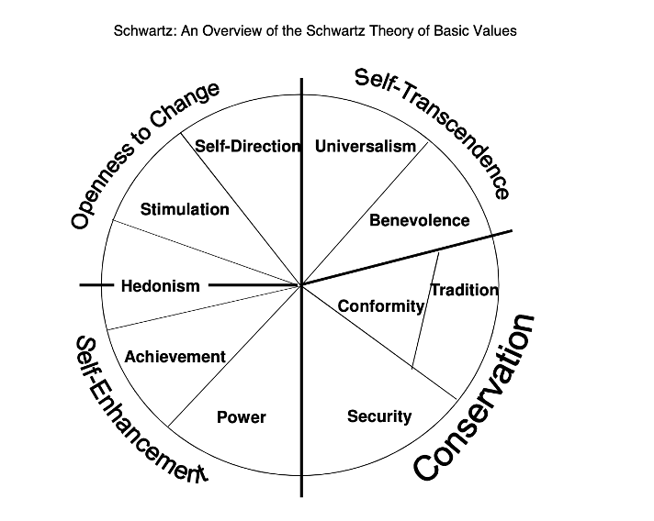
Source: https://www.academia.edu/3765891/An_Overview_of_the_Schwartz_Theory_of_Basic_Values
In this framework, growth connects to openness to change, covering learning, curiosity, and development. Impact relates to achievement and meaningful outcomes. Care reflects benevolence and the need for safety and stability. These dimensions are not always aligned, and that is precisely the point. The model helps explain why trade-offs emerge in everyday work, and why they are a natural part of how human systems function.
Shared values guide work across countries and teams
As Norrin continues to grow across countries and cultures, values provide continuity in how work is understood, without requiring everyone to work in the same way. In that sense, values are a shared reference point that helps us continuously shape what “we” actually means, together.